The EP Mafia: Part 2

The German

Today, we live in a golden era of electric propulsion. Thousands of hall effect thrusters currently inhabit space (thanks in no small part due to the comical numbers of Starlink satellites), ion thrusters have demonstrated exceptional performance in deep space, and soon the PPE will demonstrate humanity’s first high-powered on-orbit EP system with a 50 kW propulsion system. Just a few short years ago, this level of widespread adoption would have seemed like a technologist’s dream. EP has long been relegated to geostationary satellites and laboratory experiments and engineers have, for decades, toiled away attempting to make marginal improvements to technologies that were viewed as impractical by many.

The current explosion of EP utilization, and the prospects for the future of the technology, is the result of decades of diligent work by scientists and engineers. Proponents of electric propulsion have long waited for the day when their life’s work became central to so many missions. That it took so long is a true tragedy, for many of the earliest champions of EP did not live to see it.

While EP is an “advanced” technology, it’s also quite an old one. Robert Goddard noted the possibility of using electric rockets for interplanetary travel in 1906. Hermann Oberth more thoroughly investigated the possibility of using a flow of electrically charged particles for in-space propulsion in his 1929 book Wege zur Raumschiffahrt. It would take more than 30 years to go from basic principles to an operational ion thruster, with Harold Kaufmann’s electron bombardment gridded ion thruster successfully firing for the first time in 1960. It’s really quite astonishing to think that the first ion thruster was demonstrated all the way back in 1960, only two years after the introduction of the Boeing 707 and one year before Yuri Gagarin became the first human to reach space. But if the first successful demonstration of the ion thruster occurred in 1960, development must have begun several years before that. So when did electric propulsion development really begin at NASA Lewis Research Center? For that, we have to talk about Wolfgang Moeckel.

Wolfgang Moeckel was born in Germany in 1922, immigrating to the United States at the age of 5. Growing up near Dearborn, Michigan, he attended the University of Michigan and graduated with a Bachelor’s of Science in Applied Physics in 1944. He immediately packed up and moved to Cleveland, Ohio, joining the then NACA Lewis Flight Propulsion Laboratory. At the post-war NACA Lewis, the blossoming field of jet propulsion was king and Moeckel quickly made a name for himself as a talented aerodynamicist, focusing on the design of supersonic inlets and diffusers. By 1955, Moeckel was the head of the Theoretical Section of the Supersonic Propulsion Division. With the Space Race looming large on the horizon (and the United States setting the express goal of launching a satellite into space by 1957), Moeckel and several other senior engineers at NACA Lewis began a lecture series on the difficulties of beyond-atmospheric flight. Moeckel, in particular, focused on the possibility of travel to other planets and included a summary of Oberth’s electric rocket work, having read the famous book in 1949.

Wolfgang’s interest in electric rockets became more concrete when he came across papers by Ernst Stuhlinger, one of Werner von Braun’s rocket scientists on the V2. Ernst suggested that the electric rocket not only had immense potential for future spaceflight, but that it was possible now, with today’s technology. Moeckel set off to understand as much as he could about electric propulsion and how it might be applied:

“I immediately began a study of low-thrust trajectories, and the capabilities of such low thrust systems for interplanetary travel.”

Moeckel’s work on low-thrust trajectories and electric propulsion transportation architectures gained fast traction at NACA Lewis in 1956. By 1957, center leadership had authorized studies of what facilities would be required to support development of this new propulsion technology. In part, electric propulsion has the propeller to thank for its inception. As the military need for propeller-driven aircraft waned in the 1950’s, so did funding for research on non-jet aircraft engines. In 1958, Dwight D. Eisenhower signed the creation of NASA into law and not long after the Engine Propellor Research Building at the now NASA Lewis was repurposed into the Electric Propulsion Research Building (EPRB). The first vacuum chamber EP testing facility at Lewis was completed in 1959 with the world’s largest (to this day) vacuum test chambers coming on-line in 1961. Harold Kaufmann’s gridded ion thruster was successfully demonstrated at the EPRB in 1960.

Driving this investment in electric propulsion development was Wolfgang Moeckel’s work on the ambitious and promising ways in which the technology could be employed. The sheer pace of work is impressive even today, especially considering that Wolfgang had to complete his calculations largely by hand in the pre-computer era.

  • Trajectories with Constant Tangential Thrust in Central Gravitational Fields – 1959
  • Proposal for Ion Rocket Research in Space – 1960
  • Satellite and Space Propulsion Systems – 1960
  • Fast Interplanetary Mission with Low Thrust Propulsion Systems – 1961
  • Electric Propulsion for Spacecraft – 1962
  • Promises and Potentialities of Electric Propulsion: Status of Thruster Performance – 1966
  • Propulsion Systems for Manned Exploration of the Solar System – 1969
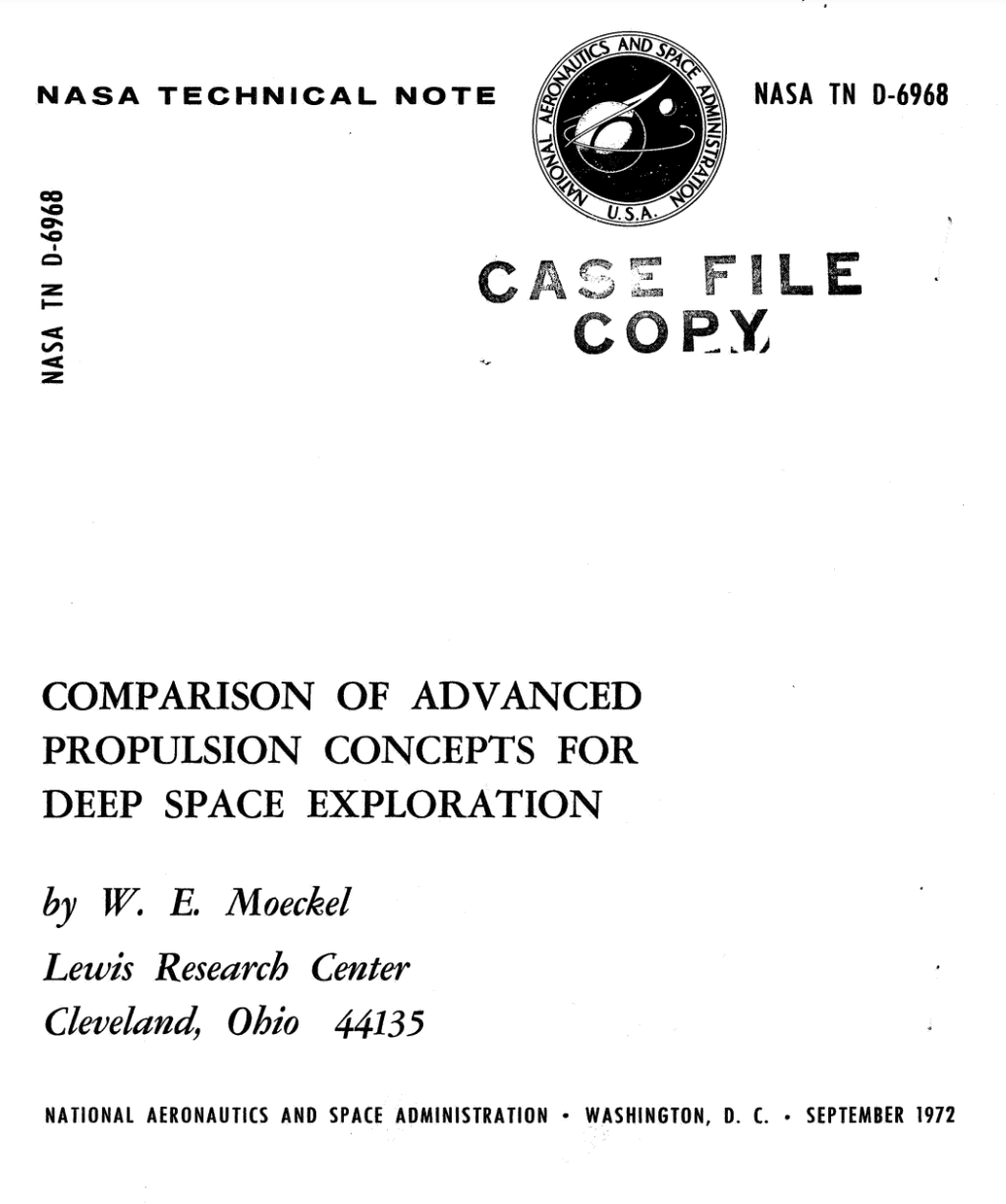
  • Comparison of Advanced Propulsion Concepts for Deep Space Exploration – 1972

The 1959 paper is really a wonder to read through the lens of today. In 1959 the United States barely had the capability to launch anything into orbit, let alone a payload with an independent propulsion system. Yet this paper describes the basics of a low-thrust spiral trajectory and includes calculations for an Earth-Mars transit trajectory. 

The 1960 Proposal for Ion Rocket Research in Space is even more impressive, considering its successful pitch resulted in the Space Electric Rocket Test (SERT) 1 mission, the first orbital demonstration of electric propulsion, in 1964.

Moeckel would later win NASA’s Exceptional Scientific Achievement Medal for his pioneering work on electric propulsion, serve as the Chief of the Electromagnetic Propulsion Division, and retire in 1978 as the Chief Scientist of NASA Lewis Research Center. He passed away in 2017 at the age of 95, having lived long enough to see ion thrusters fly on SERT-1, SERT-2, Deep Space 1, Dawn, and countless GEO communications satellites.

The story of NASA Glenn’s first mission designer resonates deeply with me. Wolfgang began his career studying boundary layers and designing supersonic inlets before becoming a world leading expert on low-thrust propulsion. Between 1955 and 1964, he not only became an expert on the theory of low-thrust trajectories and the application of electric propulsion, he became the only mission designer in the world to have actually flown an ion thruster. 

I began my career as a fluids mechanics specialist, having earned a Master’s of Science in Fluid Thermal Sciences from CWRU in Cleveland, Ohio. My master’s thesis is on the performance of pilot breathing systems in NASA fighter aircraft and my first payloads to fly in orbit included a fire experiment (Saffire), an air pump for the Combustion Integrated Rack on the ISS, and two fluids mechanics experiments. My career took a hard pivot into the world of low-thrust trajectories when I joined the PPE Mission Design team in 2020. And while I’m certainly no world leader, it’s comforting to know that someone has walked this path before. 

Wolfgang Moeckel, Harold Kaufmann, and the dozens of researchers and technologists at NACA Lewis in the late 1950’s working on electric propulsion were true believers in the potential of the technology. It is a tragedy that it took so many decades for solar array technology to advance to the point where widespread adoption of EP could become possible. The steady development of ever-better thrusters and constant advocacy of low-thrust missions was fruitless for decades, but now has enabled the future of space exploration.

I can think of no better summary of the EP Mafia than this excerpt from Moeckel’s 1960 paper:

“Before I discuss the current performance of electric thrusters, I’d like to present some thoughts on the broader subject of this panel, namely, the future of electric propulsion. In evaluating the future of a new system, one may ask whether something can be learned from the development history of older successful systems. Consider, as an example, the development of the automobile. Although there are many obvious differences between the way things were done in those days, as compared to these days, there may also be some instructive similarities.

One of the well-documented facts regarding the history of the automobile is that early owners and advocates were frequently taunted with the cry, “Get a horse!” This advice was particularly heard when, as often happened, there was a malfunction of the system (e.g., stuck in the mud) or of one of its subsystems (e.g., a flat tire) . There was at that time an existing system (horse and buggy) which was generally satisfactory for the missions for which it was designed, and had built up a very high reliability factor. Its fuel and propulsion system were reasonably inexpensive, and all subsystems had long shelf life, low maintenance cost, and were easily replaceable. Naturally, few mission planners at that time were willing to plan on using a new, more complex, system which was far from the mission hardware stage.

Such speculations are usually futile, and the recourse to history in predicting the future has many pitfalls. There is one lesson, however, that we proponents of electric propulsion can learn. When anyone taunts us with the advice “Use a chemical rocket!” we can adopt the quiet, superior smile of one who knows that history is on his side. Or, if that is not satisfaction enough, I am sure that a host of appropriate rejoinders will immediately come to mind.”

References

V.P. Dawson, “SP-4306 Engines and Innovation: Lewis Laboratory and American Propulsion Technology”, NASA Glenn Research Center, 1991.

M.J. Patterson and J.S. Sovey, “History of Electric Propulsion at NASA Glenn Research Center: 1956 to Present”, Journal of Aerospace Engineering, ASCE, April 2013.

W.E. Moeckel, “Technical Report R-53: Trajectories with Constant Tangential Thrust in Central Gravitational Fields”, NASA Lewis Research Center, 1959.

W.E. Moeckel, “Promises and Potentialities of Electric Propulsion: Status of Thrustor Performance”, NASA Lewis Research Center, 1966.

Leave a comment