I joined the PPE Mission Design team in May of 2020. At that time, I was just the third full time member of the team and I had exactly zero experience in trajectory design and optimization. I did, however, have experience in systems analysis and a pretty good understanding of how to apply the rocket equation. So while it took me a couple years to become a proficient astrodynamicist, I was able to immediately make an impact by taking over trade study and low-fidelity level analysis for the PPE-HALO co-manifested mission.
The problem statement was pretty simple. The low-thrust electric propulsion-driven spiral trajectory that PPE would take to the Moon is computationally very expensive to solve, often taking 90 minutes of clock time to compute a single solution. This trajectory is also extremely sensitive to assumptions on vehicle mass, subsystem performance, and launch date…all things that are in constant flux early in a project lifecycle. Trajectory data is also often required in order to estimate subsystem performance and inform necessary capabilities and requirements. Instead of having to design a full-fidelity reference trajectory every time analysis is needed for a new initial condition, Mission Design desperately needed the capability to rapidly assess inputs and produce results that were accurate enough to be used by other technical teams within the project.
In the summer of 2020 I began developing this low-fidelity, rapid mission analysis tool and completed the first build in late August. I ended up calling this tool NSTRDMS (NASA Spacecraft TRaDe Modelling System). Since 2020 this tool has evolved into a unique and absolutely essential capability for us. The tool itself is really quite simple, the delta-v required to complete the Lunar Transit trajectory can be estimated using a simple parameterization provided you know the performance of your launch vehicle. The full details of this are too lengthy to share here, so I will point you to a paper I published on the topic (links are at the bottom of this post). Once you know delta-v, provided you can model the performance of your power and propulsion systems, you can use the rocket equation to estimate how much propellant you need to complete the mission and with some simplifying assumptions, you can also estimate the total time of flight. It turns out, this method is pretty accurate and reliable when compared to full-fidelity Design Reference Mission (DRM) results.
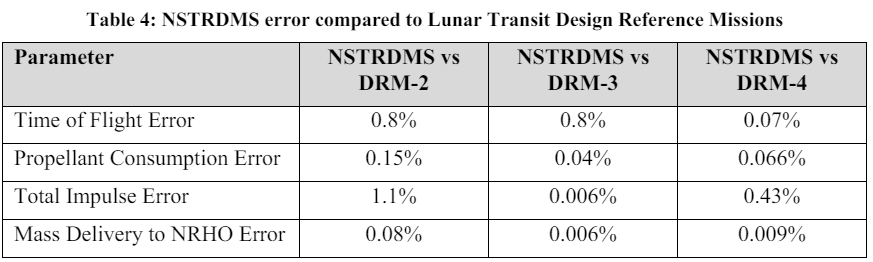
I cannot stress how absolutely vital NSTRDMS has been for Mission Design. A solution that would take 90 minutes to compute in our high fidelity tool takes less than 0.1s in NSTRDMS, meaning we can compute trade spaces of millions of solutions in a matter of minutes. We can rapidly assess the impact to various changes to our assumptions and provide guidance to project leadership on what is worth pursuing (perhaps a design change that may reduce propellant costs by several dozen kilograms) and what isn’t (something that is statistically insignificant). NSTRDMS also provides initial guesses for our high-fidelity trajectory designs which has the happy benefit of reducing the overall computing time and human effort required to design new reference trajectories. We have used NSTRDMS continuously since 2020 and once our leadership was aware of the capability they have asked for quick turn analyses often. NSTRDMS has supported architecture, CONOPS, and hardware design decisions across nearly every vehicle subsystem as well as at the combined PPE/HALO, Gateway, and even Artemis campaign levels.
During a recent and exceptionally high impact analysis effort, my lead engineer and I were discussing our discomfort with some conclusions that were being drawn from data. We had produced a large amount of data with NSTRDMS, then validated key cases in a high-fidelity environment. My lead said, “How do you feel about all of these decisions, the future of Gateway, the cornerstone of Artemis and the Moon 2 Mars campaign, being based on a couple days worth of NSTRDMS runs?”
The answer is that neither of us felt great about it. NSTRDMS is good and since I published that paper the tool has only gotten better. To the point where NSTRDMS today is barely recognizable from NSTRDMS a year ago. I’ve done a lot of work to add statistical uncertainty modeling to the tool and every data set I have produced lately has matched incredibly well with validation results. But NSTRDMS is still an approximation tool. It isn’t meant to be perfect, and now hugely important decisions about Gateway have been made because leaders need a good enough answer now, not a perfect answer later.
This moment was maybe the first time that the enormity of what we’re doing really hit me. More than just the numbers we provide, the narrative we put around those numbers and the recommendations we give have the power to irreparably alter the course of the program. This isn’t new, we’ve been providing these inputs for years. But when the project is so early in its lifecycle the things we do seem less tangible, less real. Now, hardware is being integrated. The answers we give are having material impacts on real things, on a real vehicle that will fly.
Since that short conversation I have felt the significance of our job quite a lot more. We revisit that same question more often too, “Are we comfortable committing Gateway to this course?”. The weight of our actions is palpable and I can’t help but feel it more and more these days. I’m grinding my teeth when I never used to, I have more and more grey hairs every week, and I feel like I can’t turn my brain off. I’m always thinking about the latest problem I’m working on or the newest fire that I need to fight. These projects consume you. There’s no other way around it, they take over your life and that just is how it has to be. Not everyone can live with it for long either, people transfer out to lower stress jobs all the time. Unfortunately I’ve seen people’s health deteriorate only to rebound as soon as they leave PPE. I have to applaud anyone who can put their health and their personal lives above their work, but even if I couldn’t take the stress I don’t know that I would be able to walk away.
Exploration campaigns don’t come around very often. Even in the best of careers, you might only get to work one or two development programs before you retire. The Mercury/Gemini/Apollo guys got lucky. but even the guys that developed Mercury were largely gone by the time Shuttle came around. If you got to develop Shuttle you probably weren’t around for the ISS or Orion. I have the privilege of being right in the middle of the action on PPE and Gateway, but I’m not confident I’ll be around for whatever comes after. My next flight project will likely be a lot smaller and a lot less important. How could you walk away from that? We are writing chapters in future textbooks everyday and it will be decades before another chance like this comes around.
I have a hard time talking about my job with friends outside the industry or even my family. Let alone trying to answer my doctor when they ask “are you under any stress at work?”. It’s hard to understand unless you get it. Unless you’ve been in the rooms where a handful of people decide to commit billions of dollars and the combined efforts of thousands of engineers around the world to a singular objective.
I think that’s one of the reasons why there is so much mutual respect between professionals in the industry, at least the ones that get it. There are a lot of people around the country who have said to each other, “Hey, you good with this?” when millions of dollars and human lives are on the line. The same conversation has played out millions of times over the history of space exploration, from colleagues double checking analysis to flight director polls in mission control. It’s one of the coolest parts about this endeavor to me. After all the math, all the billions spent, all the tests and numbers and reports, it all comes down to a gut check, “Flight, I am go”.
Links to my paper on NSTRDMS can be found here:
 Plotting the Course