The EP Mafia Part 3

Lineage

Life often takes a crooked, wandering, indirect path. And at the end of a journey, one often ends at a destination quite far from where they had set out to reach. This is one of those stories.

We will begin, strangely, with Mikhail Gorbachev. In the twilight of the Soviet Union, Mr. Gorbachev championed a political ideology known as Glasnost, or “openness”. As General Secretary, then President, of the Soviet Union, Gorbachev pushed for transparency and an increased level of freedom of thinking in the USSR, as well as opening the Soviet bloc economically to the West. In a rather interesting case of the butterfly effect, this political agenda and economic policy would eventually result in the the foundation of America’s future in space exploration.

In 1991, the Ballistic Missile Defense Organization (now the Missile Defense Agency) organized a field trip for John Brophy (JPL), John Barnett (JPL), John Sankovic (GRC), and David Barnhart (USAF). The group of American engineers visited the Fakel Design Bureau in Kaliningrad to examine Fakel-designed hall effect thrusters. Having come armed with a mountain of instrumentation, this team performed the first western characterization of the Fakel SPT-100 and, in the process, shocked many American technologists by confirming the claimed performance of 50% thrust efficiency at 1.35 kW. Two SPT-100’s were subsequently purchased, with one to be evaluated at NASA Glenn and one at JPL.

Fakel SPT-100 (image credit: University of Michigan)

To understand the skepticism surrounding hall effect thrusters (HETs) in the United States, it helps to understand the history of HETs in the United States. Luckily, this is a short story…there effectively was none. Glenn Research Center had investigated the use of the “hall effect” to accelerate charged ions as early as 1963. By the early 1970’s, it was determined that this line of research was a dead end and all work into thrusters utilizing the hall effect were terminated in favor of continued development of gridded ion thrusters (which had demonstrated significantly higher efficiencies). For the next 20 years, HETs largely vanished from the US. The Russians, however, had continued to develop and mature the hall effect acceleration mechanism, eventually developing a system that actually had better power conversion efficiency than equivalent-power gridded ion thrusters.

Armed with this new “stationary plasma thruster” (or SPT, with the -100 referring to the thruster diameter in millimeters), the intrepid Americans returned home and got to work. The thrusters were taken apart, tested, reverse engineered, and then improved upon with new designs. Within a decade, American laboratory models had caught up to and surpassed their Russian equivalents. By 1999, a team at NASA Glenn had developed and tested the NASA-457M, a 50kW HET running on krypton (the 457 again refers to the diameter of the thruster in millimeters). This thruster was then tested at power levels between 10 and 72kW between 1999 and 2002. The 457M now resides on a display stand in Building 301 at GRC.

NASA-457M (image credit: NASA)

While the technologists toiled away proving the life and scalability of HET thrusters, the usability of these high-powered systems was still limited by the relative capabilities of spacecraft power generation systems. The cutting edge solar arrays of the era continued to be plagued by high masses (per unit kW), with the massive ISS power system generating a mere 90kW (scarcely enough to run two NASA-457Ms). Mission planners at GRC and JPL found a convenient way around this problem in the form of nuclear fission, and proposed the Jupiter Icy Moons Orbiter, or JIMO mission.

JIMO was to be powered by a 200kW nuclear reactor, feeding up to 8x 25kW gridded ion thrusters (either the NEXIS or HiPEP systems developed at JPL and GRC, respectively), and the vehicle would transit between Callisto, Ganymede, and Europa over its mission life. JIMO deserves an entire write-up of its own, and so I will not spend too long on it here. Perhaps too ahead of its day (as well as massively expensive), JIMO was cancelled in 2005. Today, the only remnants of JIMO (at least at GRC) come in the form of the HiPEP thruster, on display at Building 301, a host of nuclear power system knowledge that continues to permeate the center, and lessons learned from designing a nuclear electric propulsion (NEP) spacecraft, which can clearly be seen in all subsequent NASA NEP designs.

As of 2005, electric propulsion had been around for a long time (with the first EP thruster having been flown in 1964) yet outside of Deep Space 1 in 1998, EP had yet to be used in any significant on-orbit application. Following the cancellation of JIMO, demonstrating the capabilities of a high-powered EP system became a prime focus for GRC and JPL mission planners. The effort to fly such a mission would eventually take two decades, involve the likes of Jim Free, and span four presidential administrations. Having learned their lesson with the far-fetched NEP system, GRC and JPL personnel instead began to focus their efforts on more readily achievable power levels, namely those below 50kW. Leveraging the development efforts of the past decade, these mission concepts began to incorporate HETs as well as gridded ion thrusters.

Artist’s conception of JIMO (image credit: NASA)

From here, the story becomes quite complex. The Constellation program came and went and, with it, the idea of a supply and fuel depot station placed in lunar orbit (with some concepts even identifying the Earth-Moon L2 Lagrange point as a staging point). Post-Constellation, the Waypoint concept furthered this idea of an EML2 logistics station, meant to be an aggregation point for lunar and deep space missions. At the heart of this station was to be a high powered solar electric propulsion (SEP) system. Included in this concept was a SEP-powered cargo tug meant to deliver 5t of payload from LEO to EML2. This SEP logistics vehicle now seems rather prescient. The design concept called for a pressurized volume (based on the Cygnus resupply vehicle) mounted to a satellite bus, powered by 40kW of solar array generation, two XR-12 (12kW) HETs and 3,000kg of xenon. We’ll revisit some of these numbers later…

Waypoint SEP cargo tug (image credit: NASA)

Waypoint, however, didn’t last long. In the post-Constellation era of the early 2010’s, there just wasn’t much institutional desire for a new human spaceflight program. The GRC and JPL teams continued their, at this point, decade-long effort to find a mission. In 2010, JPL’s Team X, a concurrent engineering team that inspired the creation of GRC’s Compass Lab, led an agency-wide study to assess the feasibility of using a SEP vehicle to rendezvous with, capture, and deliver a Near Earth Asteroid (NEA) to cislunar space. This study would gain widespread support at NASA HQ and receive authorization after a second feasibility study in 2013. The Asteroid Redirect Mission (ARM), originally the Asteroid Redirect Robotic Mission (ARRM) under the 2010 study, would finally provide a mission for high-powered EP as well as Orion and SLS. ARM, much like JIMO (and Waypoint for that matter) deserves a much lengthier deep dive than I can accomplish within this post, but there are a few things I want to highlight.

ARM, in many ways, was a continuation of the existing SEP demonstration studies that had been floated and kicked around at GRC and JPL in the late 2000’s and early 2010’s. A large bus would hold somewhere around 12t of xenon, be powered by two megaflex solar arrays (the big circular kind) generating a total of 50kW at beginning of life, and power a 40kW ion propulsion system consisting of multiple hall effect thrusters. Some versions of the mission involved wrapping a giant plastic bag around a small NEA (shown below), while others involved using mechanical articulating arms to grab a small 6 meter boulder off of a larger asteroid. Following asteroid capture, the vehicle would return to cislunar space and await a crewed mission for astronauts to study the specimen.

Asteroid Redirect Mission artist’s conception (image credit: NASA)

ARM, while it lasted longer than Waypoint, met its end relatively quickly in 2017 (after 3 years of development where the project entered Phase B). In my personal opinion, ARM was never seriously considered by the administration. It was a way to keep the agency busy and hold Orion and SLS over until more political support could be mustered for an exploration program. The efforts to define this exploration program began in earnest in 2015, with the old Waypoint concept being dusted off and revisited. By 2017, the concept known as Deep Space Gateway gained widespread support at headquarters (due in no small part to the newly signed Space Policy Directive-1). ARM’s cancellation was needed to make way for this new phase of human exploration, which would evolve into the Artemis program over the subsequent years. The SEP bus from ARM would be retooled into the Power and Propulsion Element (PPE) and form the backbone of the Deep Space Gateway. This much was confirmed at a congressional hearing on June 8th, 2017 by NASA acting administrator Robert Lightfoot.

“[The Power and Propulsion Element] would build right off of the bus that we had for the Asteroid Redirect Mission” – Robert Lightfoot (acting NASA Administrator)

ARM had spurred the development of many of the core concepts, technologies, and methodologies that now are critical to PPE and Gateway. The AEPS hall effect thruster (three of which will fly on PPE) began its life as the HERMeS thruster (Hall Effect Rocket with Magnetic Shielding), a 12kW HET originally developed in 2012 for use on ARM. Additionally, many of the trajectory design and astrodynamics methodologies and concepts now being used on Gateway were first investigated under ARM. The baselined CONOPS involved returning the NEA to a 70,000km radius lunar Distant Retrograde Orbit (DRO), the same orbit that was utilized in Artemis 1. Later in ARM’s life, a 9:2 resonant EML2 southern Near Rectilinear Halo Orbit (NRHO) became the baselined destination orbit due to lower ∆v requirements. At the time, the NRHO was simply referred to as a halo orbit or a near rectilinear orbit. The term NRHO did not enter common parlance until around 2018. Many of the trajectory design methodologies and even some of the python scripts we use today on PPE were first developed in 2014-2017 for ARM.

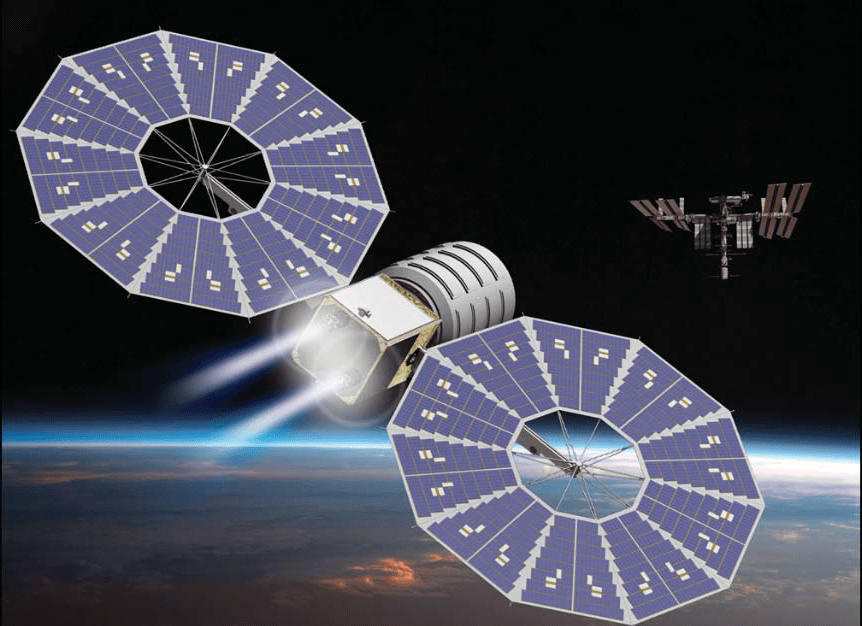
It is clear to see the lineage of PPE when you take a step back and look at all these details. PPE will carry a 50kW SEP system comprised of 3x 12kW AEPS thrusters (with direct heritage to the NASA XR-12) and 4x Busek BHT-6000s (with direct heritage to the SPT-100). The spacecraft will carry two solar arrays producing more than 60kW at beginning of life and two xenon tanks with a total of 2,770kg of propellant. Bolted to the front of the bus will be a pressurized crew habitat based on the Cygnus. The EML2 cargo bus lives, albeit in a far larger, heavier, more capable package.

PPE Artist’s conception (image credit: NASA)

Today, PPE is set to become the crowning achievement of the electric propulsion community. JIMO had set out in 2003 to demonstrate the capabilities of EP as a transportation-class architecture. Technologists have spent now six decades developing ever better thrusters. We would not have the hall effect thruster capabilities we do today without that fateful trip to Kaliningrad in 1991. ARM had picked up the pieces of shattered mission concepts and gotten closer to flight than any high-power system had before. PPE will finally put an end to this multi-decade effort and open the way for future SEP and NEP transportation architectures.

While this in itself will be a lasting achievement, what is even more impressive is the long family tree that the earliest days of SPT-100-based development has spurned. I’ll provide below a list of some notable personnel (I have missed or excluded many) who have been involved in some of these projects over the years and where they are now.


Early Thruster Development

  • John Brophy
    • Led JPL’s 2010 ARRM study
    • Brophy’s rap sheet is honestly insane and very long
  • David Manzella
    • NASA 457M/early HET development
    • HERMeS/AEPS development
    • PPE Chief Engineer
  • David Jacobson
    • Many early 2000s HET projects
    • Orion Service Module Propulsion Subsystem Manager
  • Richard Hofer
    • NASA 457M/early HET development
    • Principal Engineer/Supervisor of JPL’s EP group
  • Pete Peterson
    • Many early 2000s HET projects
    • HERMeS/AEPS development (AEPS lead engineer)
    • PPE Deputy Chief Engineer

JIMO

  • Lee Mason
    • NASA Space Technology Mission Directorate Deputy Chief Engineer
    • NASA principal technologist for power, energy, and thermal systems
  • Jon Sims
    • Supervisor/Principal Engineer, JPL mission design and navigation section
    • Dawn, Psyche, Europa Clipper trajectory design
  • Kurt Hack
    • PPE Mission Integrator
    • GRC Space Mission Architect
  • Steve Oleson
    • GRC Compass Lab Chief Engineer

SEP Demonstrator Effort

  • Jim Free
    • GRC center director
    • NASA Associate Administrator
  • Melissa McGuire
    • ARM deputy mission design lead
    • PPE Mission Design Manager
    • Gateway Low Thrust Mission Design Manager
  • David Oh
    • Lead flight director – Curiosity rover
    • Psyche Chief Engineer
  • Greg Whiffen
    • Psyche lead trajectory design engineer
  • Dan Herman
    • PPE/Gateway Electric Propulsion manager

References and Further Reading

John Brophy – Perspectives on EP

History of EP at NASA Glenn

NASA-457M Publication

JIMO Overview

Waypoint Space Station

SEP Demonstrator Concepts

ARM Overview

ARM Cancellation

Leave a comment